Maldives QI, Part 5

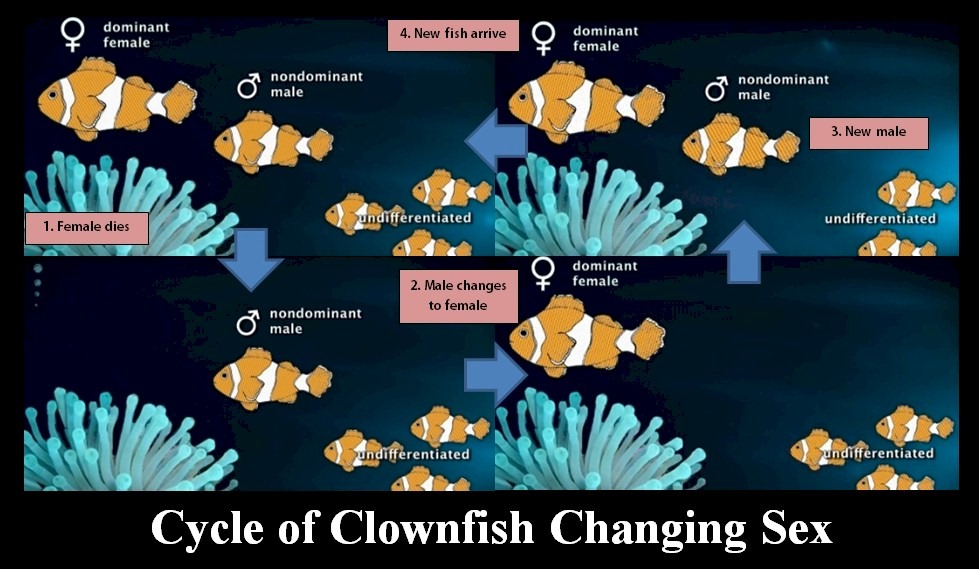
Cycle of Clownfish Changing Sex

Q: What gender was Nemo?
A: Male
** BUZZZZZ **
A: Female?
Q: Actually, neither (or both) in all likelihood. Juvenile clown fish are born as hermaphrodites who can become either males or females later in life.
Q: What gender is Nemo’s Dad?
A: Ok, definitely got this one. First, the “Dad” is grown up and no longer a juvenile. Secondly, “Dad” means he is definitely “male”.
**BUZZZZZ ** Actually, Nemo’s “Dad” might have been a “male” at one point, but the key word here is “is”. What is he today? In all likelihood he is now a “Mom”. It turns out that when a “harem” of clown fish loses its dominant female, the largest male changes its sex to become the new female.

Tonight concludes Series “L” of “QI” which means that the team are now in the process of researching Series “M”…for “Maldives”. Maldives Complete has a whole series of potential Maldives-oriented questions the QI staff could consider especially concerning the ubiquitous “Nemo” fame. The latest twist is this latest discovery of this perplexing creature…

“Some species exhibit sequential hermaphroditism. In these species, such as many species of coral reef fishes, sex change is a normal anatomical process. Clownfish, wrasses, moray eels, gobies and other fish species are known to change sex, including reproductive functions. A school of clownfish is always built into a hierarchy with a female fish at the top. When she dies, the most dominant male changes sex and takes her place. In the wrasses (the family Labridae), sex change is from female to male, with the largest female of the harem changing into a male and taking over the harem upon the disappearance of the previous dominant male. Natural sex change, in both directions, has also been reported in mushroom corals. This is posited to take place in response to environmental or energetic constraints, and to improve the organism’s evolutionary fitness; similar phenomena are observed in some dioecious plants.”
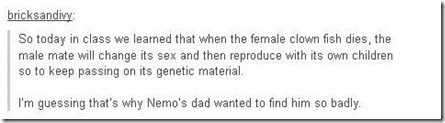
 

Finding Nemo sex change

Maldives QI, Part 4

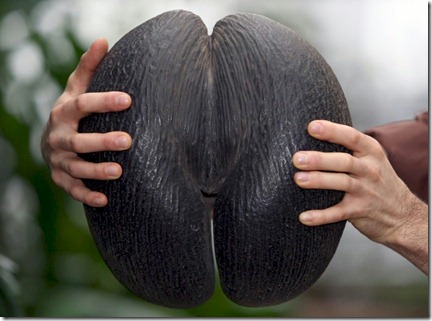
Maldives coconut

Having recently had a beer with a writer from QI and keeping up the humour, I thought it time for the next installment of ‘Maldive QI’…

  • Q: Where do you find the ‘Maldives Coconut’?
  • A: Maldives?
  • Buzzzz!

The ‘Maldives Coconut’ is very much a part of the Maldives history, but curiously not part of the Maldives itself. Der Spiegel recently did a piece on the intriguing nut

“The captain surely imagined it all a little differently. The French adventurer Francois Pyrard intended on sailing to India in 1602. But when his ship Corbin gave out on the open seas, he had to seek refuge in the Maldives. Unfortunately, the king there wouldn’t let the shipwrecked party leave for five years. When Pyrard and his crew were finally able to flee, they took the tale of the strange fruit with them back to Europe. It had been found frequently on the beaches of the islands. It wasn’t just that they were gigantic, the fruit’s shape was also reminiscent of a woman’s pelvic region. The king demanded that these alluring finds be delivered directly to him, and threatened that those who didn’t comply would lose a hand, or even be put to death. What Pyrard saw was the nut of the Coco de Mer palm, one of the rarest palm trees on the planet, also known as the Lodoicea maldivica. It is three to four times as large as an average coconut. They are also heavier than anything comparable that biologists can find, weighing up to 20 kilograms (44 pounds).”

It actually grows in the Seychelles, but makes its way to its namesake islands (“maldivica”) floating on the Indian Ocean waters which may account for its colloquial name, ‘Coco de Mer’. Der Spiegel describes this intriguing species in some detail on the occasion of the Botanical Garden in Berlin succeeding in germinating it. Despite its rather fertility-suggstive appearance, it is actually dubbed the ‘Panda of the Plant World’ for its difficulty in growing.

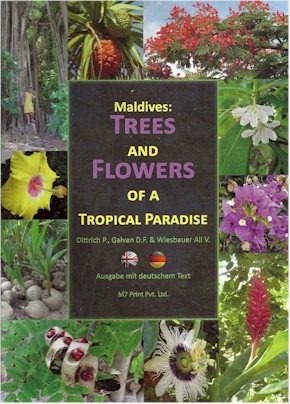
I researched the beguiling nut talking to Verena Wiesbauer Ali who not only helped with the previous QI pieces, but also co-authored the first definitive picture guide to the flora of the Maldives ‘Maldives: Trees and Flowers of a Tropical Pardise’. There are dozens of various guide books to the underwater delights of the islands, but this is the first that provides a comprehensive catalogue with dazzling colour photos for land lubbers. You can get a copy by writing to the co-authour Peter Dittrich (25 Euros) to find out what coconut palms and every other type of colourful and curious tree and plants that do grow there.

Maldives Tree and Flowers

Maldives QI, Part 3

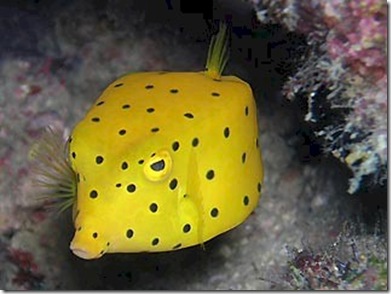
Yellow Boxfish juvenile

Question: What is this a picture of?

Answer: A Yellow Box Fish.

[Soundeffect]: Ding! Correct. You get no points because that was so easy (it is yellow and it looks like a box). Now, what is the fish below?…

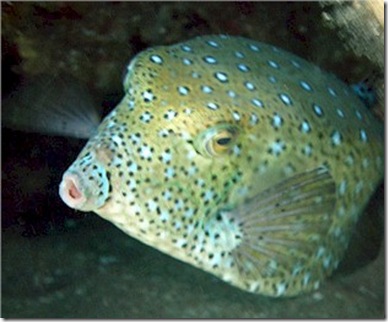
Yellow Boxfish mature

Answer: A grey/green boxfish?

[Soundeffect]: Buzzzz! Wrong. This is also aYellow Boxfish’ or Ostracion cubicus. The Yellow Boxfish, which you can see quite prevalently in the Maldives, loses its bright yellow colour as it matures.

Thanks Chase (unofficial president of the Boxfish fan club).

Maldives QI, Part 2

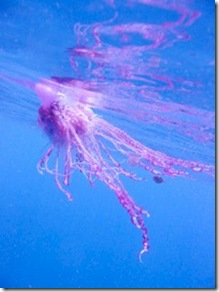
Portugese Man of War

Question: What is this a picture of?

Answer: A Jelly Fish.

[Soundeffect]: Buzzzz! Wrong. This is a ‘Portugese Man of War’ which is not actually a ‘jelly fish’ but asiphonophore. Siphonophores “differ from jellyfish in that they are not actually a single creature, but a colonial organism made up of many minute individuals called zooids. Each of these zooids is highly-specialized and, although structurally similar to other solitary animals, are attached to each other and physiologically integrated to the extent that they are incapable of independent survival.” In this respect, Portugese Man Of Wars, also know as just ‘Man of Wars’ or ‘Blue Bottles’, are more like coral polyps.

As it turns out, this fact was so obscure that it escaped the Ceremonial Master himself in the first series of QI. Stephen Fry referred to a ‘jellyfish’ as the ‘right class of animal’ as a ‘Portugese Man-of-War’. In reality, Man of Wars are not even the same of the same Order as jellyfish. They are in the order Hydrozoa, while jelly fish are in the order Scyphozoa

Bill: Forget the buzzers. Off the buzzers now. I would hazard a guess and say the, erm, the Portuguese Man-of-War.
Stephen: Oh, now, do you know, I’m gonna give you five points, ’cause you’re so much in the right class of animal.
Bill: Ah! See?
Stephen: It is a jellyfish.
Bill: A jellyfish.
Stephen: Yeah. It is a jellyfish.

Just one of the many fascinating facts we learned about Maldive ocean life during the talk by Marine Biologist Verena Wiesbauer Ali put on by Kurumba.

Maldives QI, Part 1

Stephen Fry QI

In honour of Stephen Fry’s brilliant QI (short for ‘Quite Interesting’) TV comedy quiz show returning to BBC this weekend, we feature a couple of Maldives QI questions of our own…

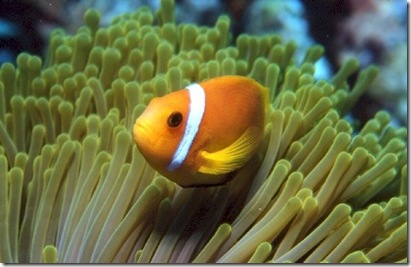
Maldives Clown Fish

Question:  What common, colourful fish in the Maldives is this a picture of?

Answer #1:  A ‘Nemo’ Fish.?

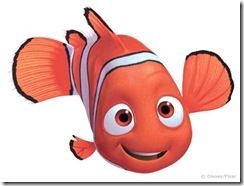
[Sound effect]: Buzzzz! Wrong. The character ‘Nemo’ in Disney’s filmFinding Nemo’ had three white stripes as a opposed to the single one shown above.

Nemo

Answer #2: A Clown Fish.

[Soundeffect]: Buzzzz! Wrong. You are close in that the term ‘clown fish’ is often applied to all members of the family of ‘Anemonefish’, but not all Anemonefish are really clown fish including this specimen.

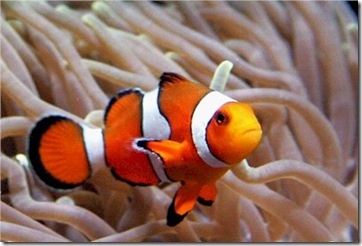
Anemonefish are from the subfamily Amphiprioninae in the family Pomacentridae and only one specific species of Anemonefish, Amphiprion ocellaris, is actually designated the ‘Clown Anemonefish’. The fish shown at top is really a ‘Amphiprion nigripes’, also known as a ‘Maldive anemonefish’.  With its cousin ‘Amphiprion clarkii’ (also known as ‘Clark’s anemonefish’ or the ‘Yellowtail clownfish’), they are the two species of Anemonefish (out of 27 that exist worldwide) found in the Maldive waters.

As it happens, a number of Anemonfish have also been dubbed ‘Clownfish’ in their informal names such as Amphiprion perideraion (Pink skunk clownfish) and the Amphiprion melanopus (Fire or Cinnamon clownfish) as well as obviously ‘Clark’s which I said is known as the ‘Yellowtail Clownfish’. But not this species here. Even Wikipedia describes the terms ‘Clownfish’ and ‘Anemonefish’ as interchangeable, but now you know the real distinctions.

Thanks to Sarah Kompatscher, Marine Biologist at Anantara, and Verena Wiesbauer Ali, Marine Biologist for Kurumba.

Clown Anemonefish

Proper ‘Nemo’ or ‘Clown Anemonefish’