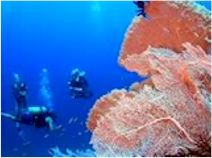
Great House Reefs

Maldives House Reefs

One of the first questions a true Maldives aficionado asks of a resort is ‘How good is the House Reef?’

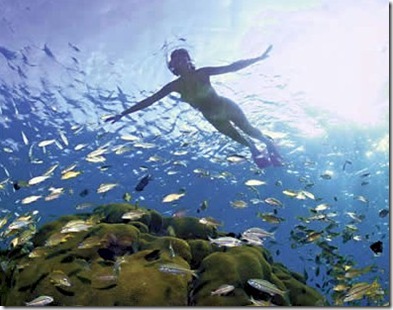
When I first heard the advice to seek out the best house reef, I didn’t even know what a house reef was. We arrived at Laguna Beach (the resort that preceded Velassaru) and spent our days snorkelling around the coral croppings in the sandy lagoon. Then on an excursion to Bolifushi (soon to be Jumeirah Vittaveli), we went ‘over the edge’ and our hearts nearly leapt out of our snorkels. It is a truly dramatic experience to go from a few feet of water to a vast open expanse with a wall peppered with colourful coral and schools of tropical fish.

When I visited Vadoo, I got into a discussion with Assistant GM Alex Kovacs about great house reefs. Alex was proudly and valiantly making the case that Vadoo’s was one of if not ‘the’ best house reef in the Maldives’. My wife and I had to have a go with that kind of endorsement and can attest that it is a thoroughly fine experience. I would call it a first class house reef, but I balked at his claim that it was ‘the best’. I’ve covered ‘house reefs’ before including ‘Best House Reef’ (based on TA research), ‘Best House Reef Drop-Off’, and ‘Closest House Reef’.

He then challenged me, what makes a ‘great house reef’? I had some immediate responses, but it subsequently made me reflect on what it the characteristics really were. I came up with the following proposed list of criteria…

  • Drop-off (minimum 20 metre drop off)
  • Access (maximum 30 metres from shore to drop off)
  • Quantity and diversity of fish (especially ‘Little Five’)
  • Quantity and diversity of coral
  • Length
  • Low current (typically on the ‘inner atoll’ side of the island)
  • Warm water (this is a given in the Maldives and many tropical destinations, but not a guarantee at other snorkel spots around the world)

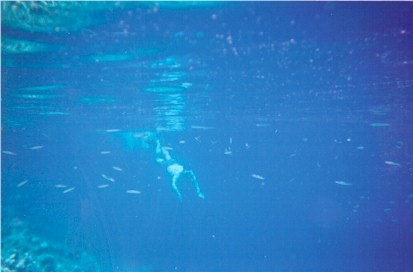
Snorkel Safari ‘Big 5’

Whale Shark snorkeling

When our family went on safari in Kruger National Park, the various resorts used to brag about how rich their park was by referencing the ‘Big Five’

  • Lion
  • Elephant
  • Rhino
  • Leopard
  • Water Buffalo

The ‘Big 5’ represented the ‘main events’ on safari. Yes, the colourful birds, curious critters, adorable primates were all wonderful to behold, but these Big 5 had a certain cachet and thrill. It became a bit of a signature to a great safari to see all five.

That Big 5 tradition made me think that ‘snorkelling’ ought to have its own ‘Big 5’. Most snorkelling excursions are dubbed ‘Snorkel Safaris’ anyway. After a decade of snorkelling, there certainly are certain creatures that spark a real enthusiasm. An acid test of distinction is whether you shout out to perfect strangers swimming near by, ‘hey, check this out!’

But actually, on reflection, they break into two groups – treats and rarities. The ‘treats’ are the ones that you would pretty much hope or even expect to see at least one of on any good snorkel…but are still a special treat. The ‘rarities’ are the ones that one hardly ever sees snorkelling, but can especially if one seeks them out.

First the basic ‘treats’ that I would dub the ‘Little 5’. Most of these are fairly common in good snorkelling sites. For one reason or another they always bring a little smile and the dive camera comes out…

  • Shark
  • Turtle
  • Ray
  • Moray
  • Lion Fish

And the more exciting rarities which are the true ‘Big 5’ and the encounters that you will talk about in the bar would include…

  • Octopus
  • Scorpion Fish
  • Dolphin
  • Manta
  • Whale Shark

This list is a distinctly Indian Ocean / Maldives list. In the same way that the ‘Big 5’ was distinctly ‘African’. Tigers, orangatangs, and sloths would certainly figure into any one’s top aspirations in Asia jungles. Similarly, the dugongs of Australia, water snakes of Indonesia and seashores of Europe and America make for special occasions in those locales.

Best of the Maldives: House Reef Drop Off – Filitheyo

Filitheyo House Reef
One of the absolute joys of the Maldives is the snorkelling. There is plenty of debate in the diving community about the top dive spots in the world. The Maldives always ranks up in the elite top with the likes of the Great Barrier Reef, Cayman Islands and the Red Sea. There don’t seem to be as many ‘top’ lists or guides for ‘snorkeling’, but it would be hard to see how the Maldives could be bested for its clarity of water, comfort of water temperature, diversity and quantity of fish, and a range of other variables.

For a snorkelling neophyte, there is a sort of progression of steps one should take to build up to the main event…

  1. Sandy lagoon – Start in the white bottomed, impossibly shallow sandy lagoon. Look at the little sand gobies, garden eels, silvery goat fish ambling by, mini humbug damsels darting in and out of tiny crevasses, trigger fish munching on strewn bits of small coral croppings.
  2. House Reef – Proceed to the area of the island where the coral aggregates into an underwater sculpture garden teaming with ever more colourful and diverse fish from the classic surgeon fish, colourful wrasses, angel fish and parrot fish, perhaps a turtle or small reef shark will make an appearance.
  3. House Reef Drop-Off – But the big event to any snorkelling is the ‘drop off’. Where the depth goes from a few meters to virtual oblivion. As you swim along the precipice, it is the closest feeling to flying without being in the air that one can have. Out in this open water, the island reef is a massive canvas of aquatic colour. The bigger space affords room for schools of jacks, oriental sweet-lips and the occasional larger visitor like a Napoleon fish or a ray.

Once you visit the ‘drop off’, the rest of the snorkelling will seem rather tame though it will always have its comforts and charms.

The resort with the deepest drop off, according to Emu72 on TripAdvisor appears to be Filitheyo, “Filitheyo has the deepest drop off in the Maldives at 90m on the NE corner, and the reef remains in fairly good shape.”

I can personally attest to how great the Filitheyo house reef is and its drop off from personal experience with me pictured above here diving into its depths.

Best of the Maldives: House Reef – Kandolhu

 Kandoludhoo House ReefKandolhu House Reef

One of the very first and most common questions to ask of any ‘Maldives Best Of’ selection is what is the ‘Best House Reef’.

Maldives is easily one of the world’s top dive areas up there with the Red Sea, the Great Barrier Reef, the Caribbean. But it really stands out for snorkelling. It’s topology of eroded atolls (check out Atoll Terms and Atoll Formation) provide endless shallow and protected areas for leisurely snorkelling as well as steeper reef walls for a different perspective.

The subject was raised on the premier travel review site, TripAdvisorWhich are the Top 10 Best Resort Reefs?” – and the expert opinion for the top one is Kandoludhoo. The assessment comes from one of TripAdvisor’s top Maldive forum experts, ‘spammie’ with 1,946 posts on the Maldives to his credit. He writes…

  • “Kandoludhoo has been not been harmed in the ’98 el nino due to lucky currents. So while the other reefs have had to recover from severe coral bleaching, Kandoludhoo looks just like the Maldives used to. To my knowledge its the only actually intact reef in the Maldives. It’s generally considered the number 1 reef because of that. It’s full of huge table corals and just impressive. Also easily accessible. However, several of the other reefs are recovering nicely and are quickly catching up again.”